
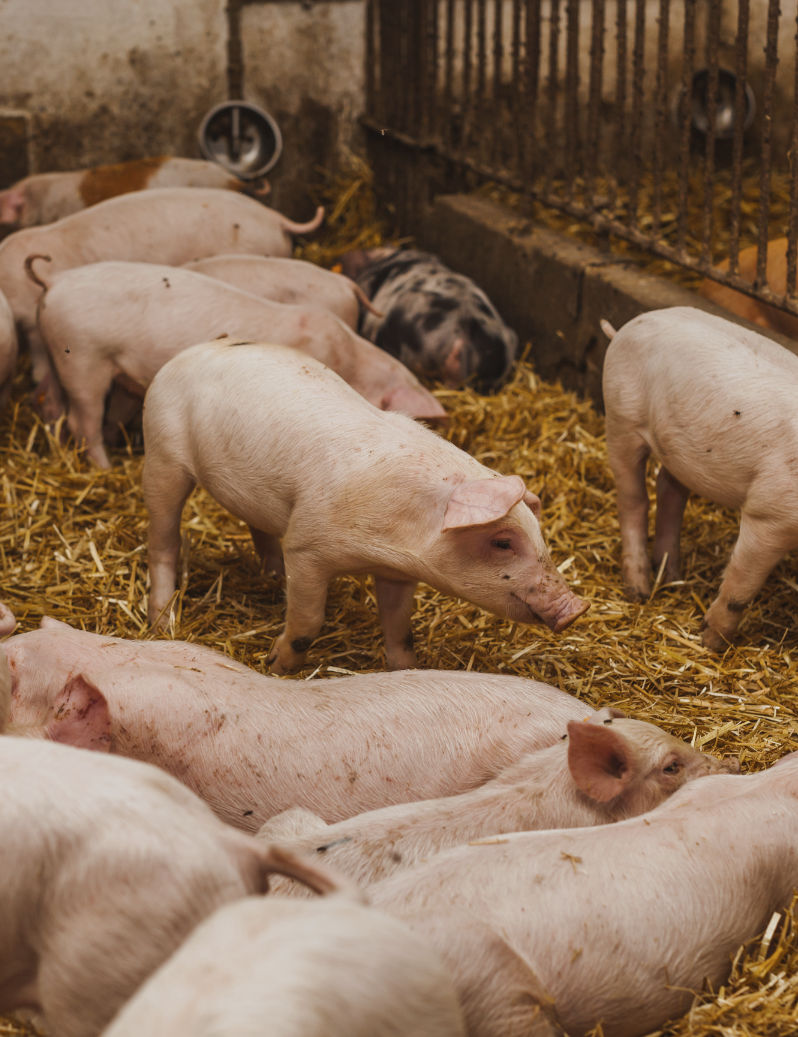
Piglet rearing, fattening pigs
0.3-1% Biochar
92,6%
Carbon content as required
3 - 30%
Moisture according to requirements
1 - 5 mm
Grain size as required
0.00006%
Total 16 EPA-PAK per kilogram
In order to guarantee a high quality standard and our purity requirement, no other substances are added.
Versatile benefits for your animals
Feed charcoal is increasingly being used in livestock farming - both in feed and in the barn. The benefits for animal health, feed efficiency, product quality and barn climate are now well documented on many farms. In contrast to scientific studies, the focus here is on everyday experience: What benefits does biochar actually bring farmers in their daily work with animals?
More and more pig farms are turning to biochar - especially as a replacement for growth-promoting antibiotics. The results are convincing: animals grow faster, stay healthier and the manure also benefits from a reduction in odor and emissions.
Practical experience
- Daily weight gain increases from 750 g to around 877 g (+17.5%)
- Same fattening performance as antibiotics, but without their Side effects
- Improved meat quality: more unsaturated, less saturated Fatty acids
- Stress reduction: lower cortisol levels, calmer behavior, Significantly less tail biting
- Stable digestion: Improved intestinal structure (villi height, mitosis rate)
- Healthier immune system: better blood values (albumin, HDL/LDL)
- More economical in the long term: fewer animal losses, reduced Treatment costs
Advantages of liquid manure and stable
- Significant odor reduction, particularly noticeable in summer
- Up to 89% less ammonia emissions, lower Nitrogen losses
- Liquid manure becomes more homogeneous, improves the fertilizing effect (liquid manure/ slurry)Soil carbon: Charging with nutrients)
- Conserves resources: more nutrients remain in the operating cycle
- Sustainable cycle: Feed charcoal goes into the Stable and later as fertilizer in the field (CO₂ sink)
Quality you can rely on
Beim Einsatz von Futterkohle in der Tierhaltung ist höchste Reinheit und Qualität entscheidend für die Gesundheit Ihrer Tiere und für maximale Sicherheit im Stall. Die im Carbotec-1-Reaktor erzeugte Futterkohle, erreicht einen PAK-Gehalt von unter 0,2 – 0,6 mg/kg – einer der besten Werte am
Markt und deutlich unter dem Grenzwerten der geforderten Standards. Maximale Sicherheit für Ihre Tiere und Erträge.